Showing posts with label space. Show all posts

Thursday, April 30, 2009

Urban Gardening - Feed the Grid

As I've mentioned before, I think the "parallel world" of metropolitan rooftops is fascinating, especially when it comes to the range of creative uses of space. For example, rooftop gardening is one way city-dwellers reclaim their space and create their own urban oases (and maybe even relieve stress, save money, eat more healthily, and help the environment) by incorporating a little nature. If you're interested in doing some urban gardening of your own, here are some resources.


CONTAINER GARDENING

Urban Gardening Help - A pretty extensive site that aims to make urban gardening easy with simple instructions.

Container Gardening Tips
- a good overview of container gardening. It includes a list of plants well suited to container gardening, which includes varieties of herbs, vegetables, fruits, flowers, shrubs and trees, and "odds and ends" (i.e. aloe, dwarf pomegranate, black bamboo).

AZ: Master Garden Manual: Container Garden - Starts out with an overview and ends with a chart of information on growing a variety of vegetables which includes:
  • light requirements
  • minimum container size
  • inches required between plants in containers
  • number of days from planting seed to harvest
  • tips for a variety of vegetables

Herb Container Gardens (Utah State University Cooperative Extension) - A PDF specific to herbs that covers the following:
  • container-friendly types
  • container sizes
  • potting media
  • planting procedures
  • care and harvest methods
  • as well as a chart with information on herb: type (annual, perennial), height of growth, maintenance, and harvest / uses.

Home Fruit, Vegetable, and Nut Gardening (Aggie Horticulture, Texas A & M) has a series of Gardening Fact Sheets and Guides which cover:
  • varieties
  • soil preparation
  • fertilizing
  • planting
  • watering
  • care during the season
  • insects and diseases
  • harvesting
  • fertilizing
  • storing

Watch Your Garden Grow (University of Illinois Extension) has a directory of many popular fruits and vegetables that provides information on:
  • varieties
  • when to plant
  • spacing & depth
  • care
  • harvesting
  • common problems
  • growing
  • selection and storage
  • nutrition and health
  • preparing and serving
  • home preservation
  • recipes

A post on Raised Garden Beds from Twenty Square Feet: Life as a Container Gardener (A Crash Course on Gardening in a Ridiculously Small Space)


POTTING SOIL RECIPES

Homemade Potting Soil Recipes for Container Gardens (The Artistic Garden) - Potting soil recipes specific to type of plant (Basic, Acid-Loving, Bulbs, Cacti and Succulents, Alpines, Orchids and Bromeliads).


COMPANION PLANTING

Companion Planting is the placement of various crops in close physical proximity to another so as to symbiotically compliment the progress of each other. Benefits can include flavor enhancement, hedged investment, level interaction, nitrogen fixation, pest suppression, positive hosting, protective shelter, and trap cropping.
  • Has a chart that covers "good neighbors", "bad neighbors", and miscellaneous notes for a wide variety of plants.

INSTRUCTABLES (Build it Yourself)

Urban Homestead Garden - an adaption on Mel Bartholomew's Square Foot Gardening practices (build up, don't dig down and organize in sq. ft.).

How to make high powered led grow lights

Instructions for building a Zero-Power Self-Watering Self-Regulating Container Garden

If you prefer to have a lot of the work done for you, purchasing an Earth Box is one way to go. You could also use this or this plan for building one yourself.


Don't have adequate space or not ready to take up gardening on your own? Visit "Just Food" to locate NYC farms nearest to you.

Sunday, April 26, 2009

Open Art

Pop over to Artists Wanted to help them answer the question: "What shapes our world more, art or design?" You'll be presented with a series images, the work of an artist on the left, and that of a designer on the right, and asked to select the one you find more moving.

The real goal of the competition, and Artist Wanted at large, is to to make the process of breaking in to the professional art world "more welcoming, dynamic and open-ended" by helping to build "new lasting opportunities for emerging talent".

Here are some of the artists and designers I had the fortune of coming across thanks to the project:

1. Melissa Furness
"Throughout my life I have been very aware of myself in relation to environment ... how the places where I have resided have formed my identity, and how human presence forms a place as well. There is an internal sense of feeling either connected or disconnected to the places in which we reside that effects all of our interactions ... The concept of a hybrid reality can be seen throughout my work in painting through a complex layering of space."

Pre-figured
2006
24in x 24in


Outlying Positions
2006
24in x 24in


For more of Melissa's work, visit: http://www.melissafurness.com/


2. Olga Nazarkina
"I searched the way to express the feeling of the infinite space being limited by the size of canvas" and to "create a sense of the abstract concept of endlessness."

The Tree of Wisdom
2007, Color Paper
2X8"
"This is the first art piece in my series of applique' works in colored paper. The thin branches are interlaced with one another, resembling A neuron pattern in the brain. Being dark and light they are life stories that comprise the tree of wisdom."


"Storm"
Sangina/ Paper, 2006
30X40"


"Dandelions"

Oil/Canvas, 2006
30X40"


Rain
Color Paper, 2007
11X8"
"The composition is created from thin strokes of colored paper. 3D quality helps to establish the mood of a poignant rain."


See more of Olga's work at: http://www.painting-olga.com


3. Mays Mayhew
"In recent work, I am exploring two concepts; one the concept of memory and two the concept of love. Memory intrigues me because it is intangible and fleeting. Existentially recalling a memory is interesting because the more one actively concentrates on a past event, the more that is uncovered. In the brain, the memories look like tiny dendrites."

No Umbrella 1
Oil/Wax Gems/Nylon Thread, (2007)
14 x 11 x 1 in.


Free Fall 2
Oil, cheesecloth, (2009)
50 x 20 x 1.5 in.


SoulMate
Oil, gems, glitter, (2009)
18 x 28 x 3 in.


For more of Mayhew's work, visit: http://www.maysmayhew.com


4. Graham Slick
"I take pleasure in the physical process of image making, be it the discovery of a more precise way to apply wiggle eyes or a new way to drip ink. No matter how complex the construction of my images, my goal is to maintain a spirit of playfulness in my work that resonates with the viewer. "

"A new idea must not be judged by its immediate results." - Nikola Tesla
2009, mixed media on wood
12 x 12 inches


The Lonely Sasquatch

2008, mixed media on found book
12 x 8 inches


See more of Graham's work at: http://www.grahamslick.com


5. Ania Baran
Young, polish, new to photography

Theatre of Dreams
Nikon D40
2009


Cracow
Nikon D40
2009


The Morfeusz gifts
Nikon D40


For more of Ania's work, visit: http://www.usefilm.com/photographer.asp?ID=375473

Tuesday, April 21, 2009

Teeny Stuff


Structures and sculptures that are tiny in scale are engaging: dioramas, miniatures, dollhouses, models, snow globes, terrariums ... I think it's because of the range of responses they can create in the observer: on one hand, they can draw you in to a new miniature parallel world ... on the other, they can make you feel like an outside entity: completely removed and all-perceiving.

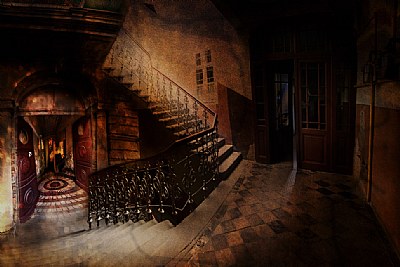
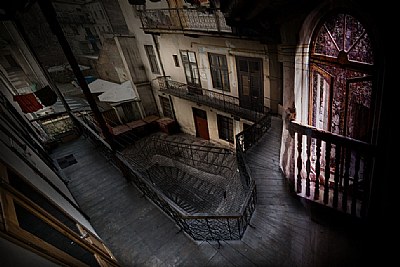
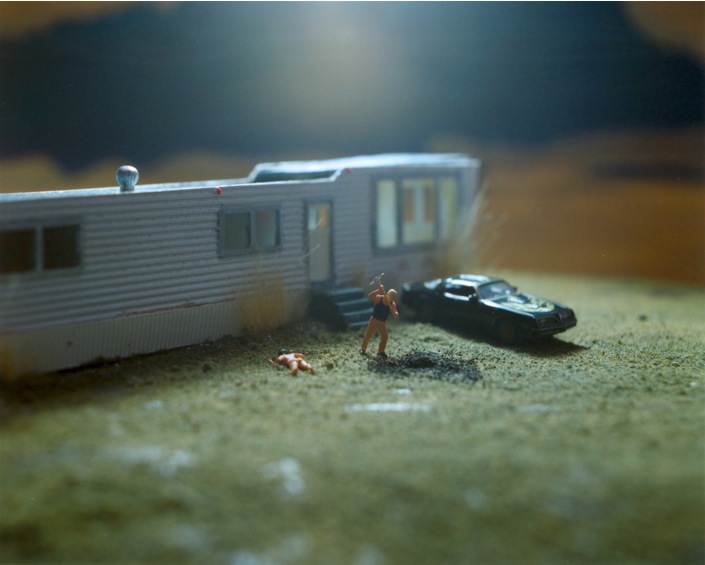
Take the miniature dramatic art of Lori Nix,


Jonah Samson's (Dark and Dirty) Dioramas,


and the amazing works of Walter Martin & Paloma Muñoz. They include tiny islands:


... and snow globes:


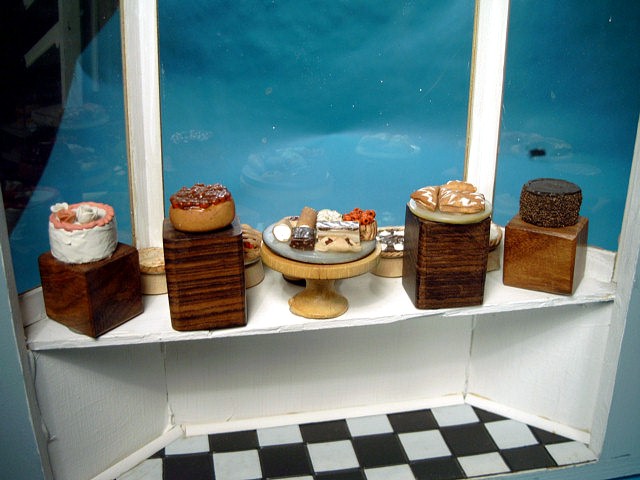
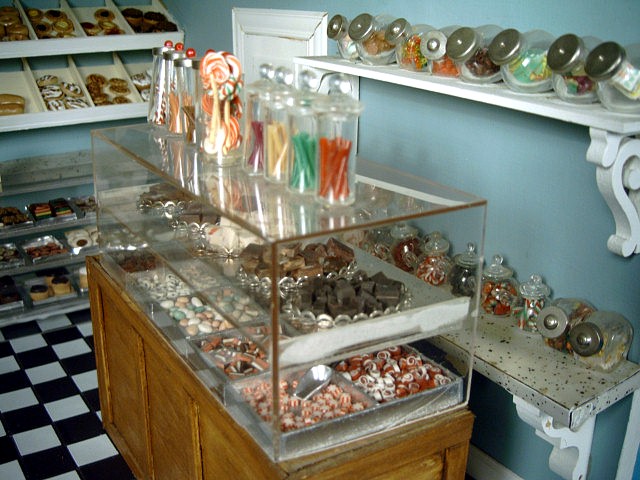
When the sculptures / structures also have a tactile component, there is an added bonus of being able to engage both your senses of sight and touch. For example, it's hard to see a snow globe without wanting to pick it up and shake it, or look at this "Room Box" of a bake shop and candy store and not want to hold one of the tiny cakes:


A closer look:


In a lot of ways, the miniature arts are limited only by the imagination.

Make the world's smallest orange,


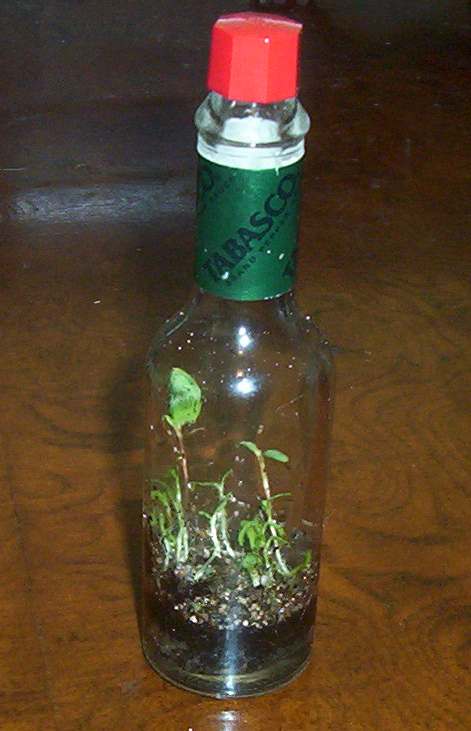
a terrarium in a mini Tabasco bottle,


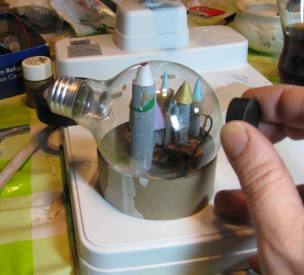
a castle inside a lightbulb diorama,


... or decorate your ceiling with a parallel world, like artist Ji Lee: "People decorate their walls and floors, but most of them overlook their ceilings. It's such a waste of vast space. So I started to install miniature parallel worlds on the ceilings."


Layers of a City

“Most people experience their life in the city in a two-dimensional way ... You know, they go from Point A to Point B along streets and don’t realize there are these multiple layers to the city. By going 20 feet below or 20 feet above, you can go to a place that is practically unvisited, that maybe 100 people get to see a year.” (NYTimes: "Children of Darkness")

Upper Level
Any time I'm on a rooftop in the city, I'm struck by the feeling that I'm on another plain. There's a whole other world going on up there. There are "rooftop neighbors", not just next door, but across the street, and way down the block ... From my roof, I can see how people create their own little havens on their slice of metropolitan rooftop real estate. My neighbors are so comfortable that they frequently come out on their porch in their underwear. When I peer down to the street below, sometimes it almost seems wrong to be looking down over the pedestrians as they pass by, completely oblivious to my gaze or anything beyond their more immediate surroundings.

Truth is, most of us don't even consider some of the things that are actually going on up on those rooftops: there are
amazing views, secret gardens, yoga classes, parties, film screenings .... eh, beekeeping? But we just shuffle by, unaware, on the sidewalk many stories below.


Lower Level
But it's not just what's above our heads that we often fail to notice, it's what's under our feet as well.

"New Yorkers go about unaware of what is happening just beneath their feet: Power pulses, information flies, and steam flows. The city’s infrastructure starts just below street level, but it doesn’t stop there. " (National Geographic: NY Underground)


Go to the National Geographic "NY Underground" site where you can actually interact with the layers in the image above and get more information and (photo, text, and audio) tours.

Also check out NYC24's feature on Exploring NYC's Underground.


See stunning visuals captured by a "Guerrila Historian in Gotham" at Undercity.


Want to see some of this stuff in person?
In a post-9/11 world, much of what was once somewhat accessible is off-limits, so it can be challenging.

  • For a more legal route, join in on the annual openhousenewyork weekend: "America's largest architect and design event ... discover new neighborhoods, explore with friends and family, and experience NYC's architecture and design in all five boroughs through special talks, tours, performances and family-friendly workshops – all free of charge...". This next one will be October 10 & 11, 2009.

  • For the other route, check out what the LTVsquad us up to.

Saturday, April 11, 2009

"Feel" better

We all have a unique place in this world. Take a look at "Secret Worlds: The Universe Within" to increase your understanding of both the vastness and connectedness of the universe, and be humbled by your place in it.

Human beings use many different cues to determine our location, and all of our senses can be involved. Consider sitting in a lawn chair on the beach - you feel sand on your toes, taste and smell the salt of the ocean in the air, hear the waves crashing, and see see the sun directly overhead as you squint through your sunglasses and realize it's about lunch time.


All of our sense are very important in helping us determine our place in the world. Here, I focus on our sense of touch and how it can be used to expand an awareness of our surroundings.

Consider the "feelSpace belt", which can help you "develop an unerring sense of direction". It deepens your awareness of your location by constantly alerting you which direction is north. The belt has sensors all around it, and no matter which direction you're facing, the northernmost facing sensor will vibrate against your skin. Test subjects reported a lasting increase in spatial intelligence, because, even after they took the belt off, they were still able to sense which direction was north and had general feeling of always being able to find their way.

Over at the Ririan Project there's an article that talks about how to sharpen your senses. It provides the following examples of ways to keep your sense of touch from dulling:

If you usually barehand it when batting, putting, or serving, go gloved for your practice swings. “Placing material between your skin and what you’re gripping will force the receptors to work harder as they try to feel through the barrier,” says Tiffany Field, Ph.D., founder of the Touch Research Institute at the University of Miami school of medicine.

Take the gloves off for the game and you’ll get a boost in sensitivity that will give you greater control.

In the wrong hands, skin can be a blunt instrument. “Without regular stimulation, your skin receptors become less sensitive,” says Dr. Field. Sex is one source of stimulation, especially if body oil enters the equation.

But you can also get a hot-stone massage, go for a swim in bracingly cold water, or use a long-handled bristle brush instead of a wimpy washcloth. Then have more sex.

Speaking of sex, aparently, by playing video games with a lot of action, women can close the gap between the sexes in spatial skills. "On average, women are not quite as good at rapidly switching attention among different objects", say researchers at the University of Toronto. This is a suspected reason for why women (debatably) don't do as well as men on spatial tasks (i.e. reading a map, driving a car, assembling a grill). This study found that after only 10 hours of play, women caught up to men in spatial skills and the change was still present 5 months later.

We can also expand our sense of touch by using it in place of other senses, (i.e. "see with your hands") as with this art exhibition of "tactile photography".

Our sense of touch, like all of our senses is elastic and can be expanded upon more than we know. Never underestimate the power it can hold.